Update AnyDesk FreeBSD to version 6.1.1
What patches are you missing?
CVE Vulnerabilities for AnyDesk FreeBSD
| CVE | Published | Severity | Details | Exploitability | Impact | Vector |
| CVE‑2026‑15682 | 2026‑07‑13 22:16:46 | MEDIUM (6) | AnyDesk Support Information Link Following Denial-of-Service Vulnerability. This vulnerability allows local attackers to create a denial-of-service condition on affected installations of AnyDesk. An attacker must first obtain the ability to execute low-privileged code on the target system in order to exploit this vulnerability. The specific flaw exists within the Send Support Information feature. By creating a junction, an attacker can abuse the service to create arbitrary files. An attacker can leverage this vulnerability to create a denial-of-service condition on the system. Was ZDI-CAN-26645. | 2 | 4 | LOCAL |
| CVE‑2026‑15681 | 2026‑07‑13 22:16:46 | MEDIUM (6) | AnyDesk Screen Recording Link Following Denial-of-Service Vulnerability. This vulnerability allows local attackers to create a denial-of-service condition on affected installations of AnyDesk. An attacker must first obtain the ability to execute low-privileged code on the target system in order to exploit this vulnerability. The specific flaw exists within the handling of screen recording files. By creating a junction, an attacker can abuse the service to create arbitrary files. An attacker can leverage this vulnerability to create a denial-of-service condition on the system. Was ZDI-CAN-26591. | 2 | 4 | LOCAL |
| CVE‑2025‑27919 | 2025‑11‑06 18:15:41 | HIGH (8) | An issue was discovered in AnyDesk through 9.0.4. A remotely connected user with the "Control my device" permission can manipulate remote AnyDesk settings and create a password for the Full Access profile without needing confirmation from the counterparty. Consequently, the attacker can later connect without this counterparty confirmation. | 4 | 4 | NETWORK |
| CVE‑2025‑27918 | 2025‑11‑06 18:15:41 | CRITICAL (10) | An issue was discovered in AnyDesk for Windows before 9.0.5, AnyDesk for macOS before 9.0.1, AnyDesk for Linux before 7.0.0, AnyDesk for iOS before 7.1.2, and AnyDesk for Android before 8.0.0. It has an integer overflow and resultant heap-based buffer overflow via a UDP packet during processing of an Identity user image within the Discovery feature, or when establishing a connection between any two clients. | 4 | 6 | NETWORK |
| CVE‑2025‑27917 | 2025‑11‑06 18:15:41 | HIGH (8) | An issue was discovered in AnyDesk for Windows before 9.0.5, AnyDesk for macOS before 9.0.1, AnyDesk for Linux before 7.0.0, AnyDesk for iOS before 7.1.2, and AnyDesk for Android before 8.0.0. Remote Denial of Service can occur because of incorrect deserialization that results in failed memory allocation and a NULL pointer dereference. | 4 | 4 | NETWORK |
| CVE‑2025‑27916 | 2025‑11‑06 18:15:40 | HIGH (8) | An issue was discovered in AnyDesk for Windows before 9.0.6 and AnyDesk for Android before 8.0.0. When the connection between two clients is established via an IP address, it is possible to manipulate the data and spoof the AnyDesk ID. | 4 | 4 | NETWORK |
| CVE‑2024‑12754 | 2024‑12‑30 17:15:07 | HIGH (8) | AnyDesk Link Following Information Disclosure Vulnerability. This vulnerability allows local attackers to disclose sensitive information on affected installations of AnyDesk. An attacker must first obtain the ability to execute low-privileged code on the target system in order to exploit this vulnerability. The specific flaw exists within the handling of background images. By creating a junction, an attacker can abuse the service to read arbitrary files. An attacker can leverage this vulnerability to disclose stored credentials, leading to further compromise. Was ZDI-CAN-23940. | 4 | 4 | NETWORK |
| CVE‑2023‑26509 | 2023‑07‑03 15:15:10 | HIGH (8) | AnyDesk 7.0.8 allows remote Denial of Service. | 4 | 4 | NETWORK |
| CVE‑2022‑32450 | 2022‑07‑18 13:15:10 | HIGH (7) | AnyDesk 7.0.9 allows a local user to gain SYSTEM privileges via a symbolic link because the user can write to their own %APPDATA% folder (used for ad.trace and chat) but the product runs as SYSTEM when writing chat-room data there. | 2 | 5 | LOCAL |
| CVE‑2021‑44426 | 2022‑09‑12 21:15:09 | HIGH (9) | An issue was discovered in AnyDesk before 6.2.6 and 6.3.x before 6.3.5. An upload of an arbitrary file to a victim's local ~/Downloads/ directory is possible if the victim is using the AnyDesk Windows client to connect to a remote machine, if an attacker is also connected remotely with AnyDesk to the same remote machine. The upload is done without any approval or action taken by the victim. | 3 | 6 | NETWORK |
| CVE‑2021‑44425 | 2022‑09‑12 21:15:09 | MEDIUM (7) | An issue was discovered in AnyDesk before 6.2.6 and 6.3.x before 6.3.3. An unnecessarily open listening port on a machine in the LAN of an attacker, opened by the Anydesk Windows client when using the tunneling feature, allows the attacker unauthorized access to the local machine's AnyDesk tunneling protocol stack (and also to any remote destination machine software that is listening to the AnyDesk tunneled port). | 3 | 4 | ADJACENT_NETWORK |
| CVE‑2021‑40854 | 2021‑10‑14 05:15:08 | HIGH (8) | AnyDesk before 6.2.6 and 6.3.x before 6.3.3 allows a local user to obtain administrator privileges by using the Open Chat Log feature to launch a privileged Notepad process that can launch other applications. | 2 | 6 | LOCAL |
| CVE‑2020‑35483 | 2021‑01‑11 15:15:13 | HIGH (8) | AnyDesk before 6.1.0 on Windows, when run in portable mode on a system where the attacker has write access to the application directory, allows this attacker to compromise a local user account via a read-only setting for a Trojan horse gcapi.dll file. | 2 | 6 | LOCAL |
| CVE‑2020‑27614 | 2020‑12‑09 00:15:13 | HIGH (8) | AnyDesk for macOS versions 6.0.2 and older have a vulnerability in the XPC interface that does not properly validate client requests and allows local privilege escalation. | 2 | 6 | LOCAL |
| CVE‑2020‑13160 | 2020‑06‑09 17:15:10 | CRITICAL (10) | AnyDesk before 5.5.3 on Linux and FreeBSD has a format string vulnerability that can be exploited for remote code execution. | 4 | 6 | NETWORK |
| CVE‑2019‑25261 | 2026‑02‑03 15:16:10 | HIGH (9) | AnyDesk 5.4.0 contains an unquoted service path vulnerability in its Windows service configuration that allows local attackers to potentially inject malicious executables. Attackers can exploit the unquoted binary path to place malicious files in service executable locations, potentially gaining elevated system privileges. | 0 | 0 | LOCAL |
| CVE‑2018‑13102 | 2018‑07‑03 16:29:00 | MEDIUM (7) | AnyDesk before "12.06.2018 - 4.1.3" on Windows 7 SP1 has a DLL preloading vulnerability. | 0 | 0 | NETWORK |
| CVE‑2017‑14397 | 2017‑09‑12 21:29:00 | HIGH (8) | AnyDesk before 3.6.1 on Windows has a DLL injection vulnerability. | 0 | 0 | NETWORK |
| CVE‑2016‑20094 | 2026‑06‑19 15:16:33 | HIGH (9) | AnyDesk 2.5.0 contains an unquoted service path vulnerability that allows local users to execute arbitrary code with SYSTEM privileges by exploiting the service installation. Attackers can insert malicious executables in the system root path that execute with elevated privileges during application startup or system reboot. | 0 | 0 | LOCAL |

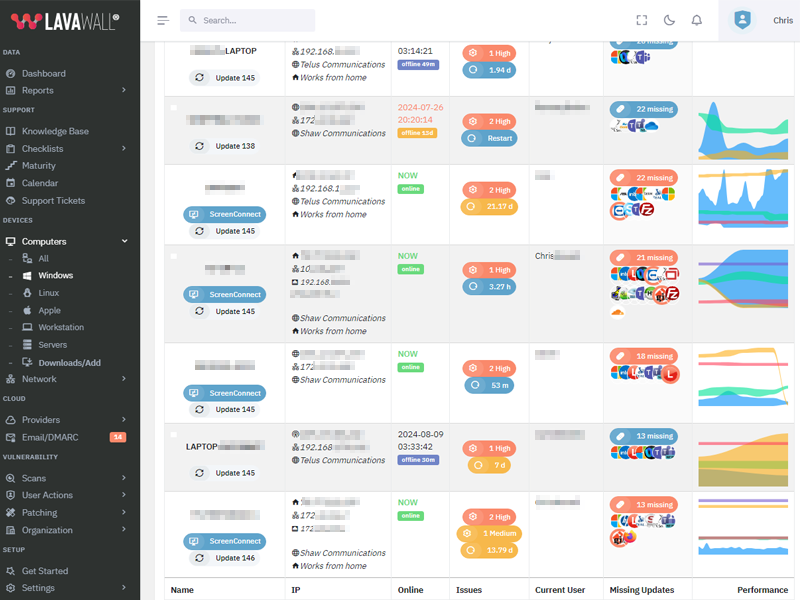
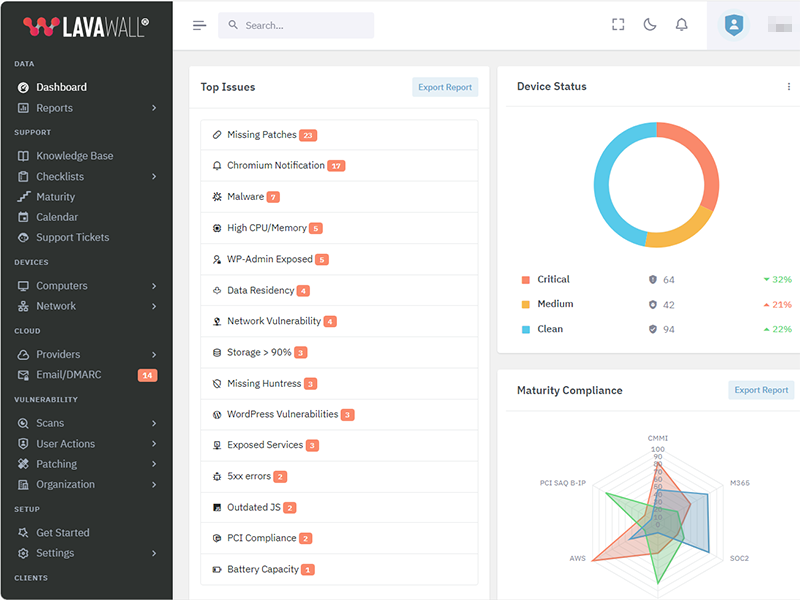
Get the IT stuff done that nobody wants to do.
Patch more applications, achieve compliance, and prevent problems while reducing stress with Lavawall®.
Security First
A security tool by security auditors. From Passkeys and Argon2i to source validation and MVSP principles, Lavawall® has you covered.
Constant Improvement
More features and more security added nearly every day.
More patchable programs added every week
While Ninite and other patching tools have had the same patch offerings for decades, we're monitoring stats to keep adding the most useful prorgams.
Details matter
From wrapping TLS communications in extra encryption and uninstalling remote support tools when they aren't used to detailed statistical analysis of system and network performance, Lavawall® goes in-depth.
Chromium extensions and Notification Validation
Lavawall®p; goes beyond patches and breach detection. We also monitor for risky Chromium extensions and allowed notifications that might be part of a phishing or ransomware attack.
Extended Cloud Security
Extend the security features of Cloudflare, Microsoft, Google, Sophos, and other cloud providers to create a Lavawall® of protection
Secure Remote Management
Even if you used breached remote management tools like ScreenConnect through Lavawall® when it was vulnerable, your computers stayed safe because we only install the agent when it needs to be used.
Integrations and automation
Easily deploy, monitor, and analyze security tools like Huntress, AutoElevate, and Sophos. Magically gain details from ZenDesk, ConnectWise, Datto, Panorama9, Microsoft, and Google.
Human and automated support
Get immediate fixes, user notifications, admin notifications -- and even security-certified human level 3 support when our advanced statistical analysis confirms a problem or anomaly.
| 2026‑09‑03 | 1.0.163.441 | |
| 2026‑08‑19 | 1.0.149.427 | |
| 2026‑08‑04 | 1.0.141.419 | |
| 2026‑07‑30 | 1.0.140.418 | Install mac remote shell script |
| 2026‑06‑19 | 1.0.131.409 | |
| 2026‑04‑02 | 1.0.115.393 | |
| 2026‑03‑12 | 1.0.113.391 | |
| 2026‑02‑12 | 1.0.104.382 | Processes and Packages improvements |
| 2026‑02‑10 | 1.0.100.378 | Processes and Packages improvements |
| 2025‑10‑02 | 1.0.82.360 | Processes and Packages improvements |
| 2025‑09‑23 | 1.0.79.357 | |
| 2025‑07‑16 | 1.0.42.320 | |
| 2025‑06‑13 | 1.0.14.292 | |
| 2025‑06‑03 | 1.0.2.280 | |
| 2025‑05‑12 | 0.12.77.264 | |
| 2025‑05‑07 | 0.12.76.263 | add tpm complience check and ensure consistent memory gathering in windows/linux/mac |
| 2025‑05‑05 | 0.12.74.261 | add tpm complience check and ensure consistent memory gathering in windows/linux/mac |
| 2025‑04‑23 | 0.12.68.255 | Uninstallation and update refinements |
| 2025‑04‑17 | 0.12.66.253 | Reliability improvements |
| 2025‑04‑15 | 0.12.65.252 | |
| 2025‑03‑27 | 0.12.64.251 | Add efficiency to package management system |
| 2025‑03‑10 | 0.12.60.247 | |
| 2025‑03‑04 | 0.12.58.245 | |
| 2025‑03‑03 | 0.12.57.244 | Add TPM complience check and ensure consistent memory gathering in windows/linux/mac |
| 2025‑02‑28 | 0.12.56.243 | Windows RAM reporting and persistent scalability framework enhancements |
| 2025‑02‑27 | 0.12.55.242 | Battery health refinements |
| 2025‑02‑26 | 0.12.54.241 | Add battery health statistics |
| 2025‑02‑26 | 0.12.53.240 | |
| 2025‑01‑29 | 0.12.35.222 | Risk score refinements |
| 2025‑01‑17 | 0.12.29.216 | Enhanced compliance and non-standard AV |
| 2025‑01‑13 | 0.12.28.215 | Improved process graphs |
| 2025‑01‑07 | 0.12.27.214 | Antivirus details, compliance |
| 2024‑12‑27 | 0.12.24.211 | |
| 2024‑12‑02 | 0.12.19.206 | |
| 2024‑11‑22 | 0.12.18.205 | |
| 2024‑10‑30 | 0.12.8.195 | Mac update refinements |
| 2024‑10‑25 | 0.12.3.190 | |
| 2024‑10‑21 | 0.12.0.187 | Macos implementaiton, linux and windows improvements |
| 2024‑10‑16 | 0.11.128.186 | Linux stats and system information improvements, improvements for application shutdown |
| 2024‑09‑12 | 0.11.113.171 | CPU Optimizations and Packages reliability improvements |
| 2024‑09‑05 | 0.11.106.164 | Phased deployment enhancements |
| 2024‑09‑04 | 0.11.103.161 | |
| 2024‑09‑02 | 0.11.102.160 | CPU Optimizations and Packages reliability improvements |
| 2024‑08‑30 | 0.11.99.157 | CPU Optimizations and Packages reliability improvements |
| 2024‑08‑29 | 0.11.98.156 | CPU utilization and console event optimization |
| 2024‑08‑28 | 0.11.97.155 | Reliability to detect unusual updates like redistributables. |
| 2024‑08‑27 | 0.11.96.154 | |
| 2024‑08‑26 | 0.11.95.153 | Faster response for reboot requests |
| 2024‑08‑20 | 0.11.92.150 | Additional package upgrade pre-requisites |
| 2024‑08‑15 | 0.11.89.147 |
| 2024‑05‑20 | 253 | Added cleanup of old .json files during a re-install |
| 2024‑05‑13 | 252 | Added apt-get update to install |
| 2024‑05‑06 | 248 | Allow restart to use /var/run/reboot-required if needrestart is not installed |
| 2024‑04‑22 | 239 | Improve internal update and version tracking |
| 2024‑04‑15 | 235 | Add support for Yum packages |
| 2024‑04‑08 | 233 | Align patching with Windows patch reporting |
| 2024‑04‑02 | 228 | Add support for needrestart |
| 2024‑03‑04 | 224 | Schedule restarts |
| 2024‑03‑25 | 221 | Add support for apt packages |
| 2024‑03‑18 | 212 | Implement release management |
| 2024‑03‑11 | 202 | Add user login monitoring |
| 2024‑03‑04 | 189 | Enhance installation reliability |
| 2024‑02‑26 | 187 | Exapand triggers to identify if the instance needs to be restarted |
| 2024‑02‑19 | 146 | Improve compatibility for non-AWS instances |
| 2024‑02‑14 | 138 | Add self-uninstall capabilities |
| 2024‑02‑12 | 135 | Enhance scheduling flexibility |
| 2024‑02‑07 | 132 | Add kernel version tracking |
| 2024‑02‑05 | 124 | Add device hash to cryptographic self-update script validation |
| 2024‑01‑29 | 107 | Enhance encryption of patch data |
| 2024‑01‑22 | 98 | Improve how available storage is calculated |
| 2024‑01‑15 | 97 | Move initial tasks from installation file to sub scripts |
| 2024‑05‑21 | 91 | Improve multi-distribution compatibility |
| 2024‑05‑21 | 79 | Improve encryption reliability |
| 2023‑12‑11 | 68 | Enhance cryptographic validation of new scripts before updating |
| 2023‑11‑20 | 62 | Add inner layer of AES encryption in case TLS inspection doesn't allow for a secure connection |
| 2023‑11‑27 | 56 | Additional base cases for resiliancy |
| 2023‑11‑20 | 54 | Additional headers added to authentication process during installation. |
| 2023‑11‑20 | 53 | Enhanced key management |
| 2023‑11‑15 | 51 | Add insecure installation parameter to allow installation in environments with TLS inspection or other machine-in-the-middle situations. |
| 2023‑11‑06 | 42 | Enhance redundant encryption during installation. |
| 2023‑10‑30 | 33 | Improve install-over compatibility |
| 2023‑10‑23 | 18 | Add reboot configuration and scheduling |
| 2023‑10‑23 | 17 | Add self-updating functionality. |
| 2023‑10‑16 | 15 | Add Linux patching information for apt |
| 2023‑10‑09 | 14 | Collect system information |
| 2023‑10‑09 | 13 | Add Linux distribution information |
| 2023‑09‑30 | 12 | Add memory monitoring |
| 2023‑09‑30 | 10 | Add hardware information |
| 2023‑09‑23 | 9 | Add AWS information |
| 2023‑09‑23 | 8 | Add customized schedule capability for configuration updates |
| 2023‑09‑23 | 7 | Add support for package monitoring using package and dpkg logs |
| 2023‑09‑16 | 6 | Add storage data configuration gathering |
| 2023‑09‑16 | 5 | Add CPU information |
Lavawall® was built from the ground up with these concerns and the Minimum Viable Secure Product requirements in mind.
Some of the controls we implemented include:
- PassKeys as the preferred primary authentication at no additional cost
- Single Sign-on using modern, maintained, and industry-standard protocols for all customers at no additional cost
- Multi-Factor Authentication as a non-negotiable default
- Encrypting communications the same way as TLS again within the TLS tunnel, so we can allow TLS inspection without breaking like Huntress or disclosing security vulnerabilities to eavesdroppers.
- Encouraging external vulnerability reports and customer testing
- Passwords checked against popular disclosed passwords, hashed before they leave your computer, and then stored using Argon2id
- Not requiring the use of passwords at all. We consider them a temporary backup authentication in case you can't use passkeys or SSO.
Lavawall® databases and front-end systems are hosted with AWS in Montréal, Québec, Canada.
We send emails through AWS in Ireland and dedicated servers in Calgary, Alberta, Canada.
We send text messages for additional identity verification through Twilio in the United States.
We store executables and pass requests through Cloudflare at your nearest edge location.
We use Cloudflare for risk management, turnstile, and web application firewall services.
We use LeadPages for landing pages.
We use Google and Facebook for analytics on our public-facing pages, but they do not have access to the console.
We integrate with third-party tools, such as Microsoft, Google, Huntress, Screen Connect, Axcient, and Datto in their respective locations. However, you must initiate these integrations through single sign-on or by enabling them in your Lavawall® console.
Active security by design
Lavawall® is under active development with the latest release on
5+
Interfaces
150+
Monitored Applications
7+
System Metrics
Actively manage your IT with Lavawall®
Patching
Updates Beyond Windows
Lavawall® prevents the 80% of breaches and failed audits due to missing patches and updates.
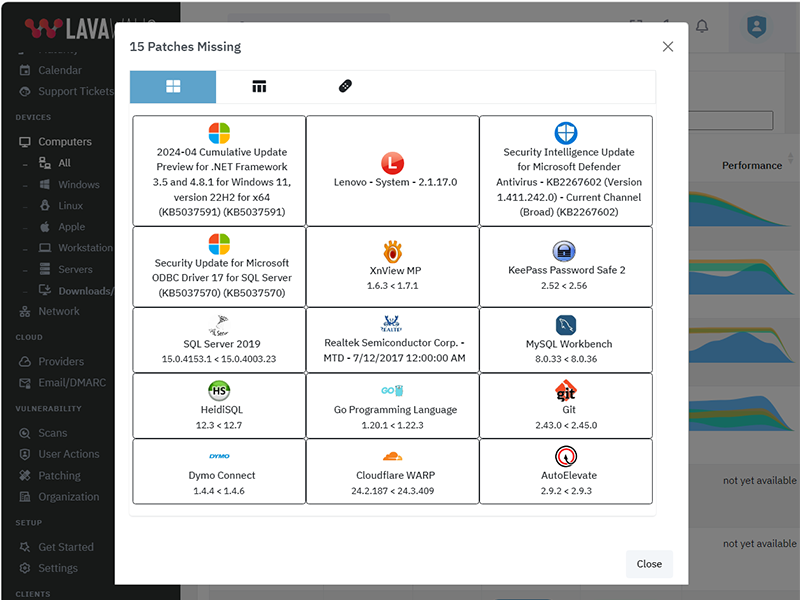
You can reduce application patching delays from 67 days to nearly immediate with the 150+ applications that Lavawall® monitors and patches.
Patch release monitoring
Monitor everything without having to select packages or “managed applications”
Patch impact classification
Standard and optional Windows patches